
Work is a bit sh*t isn't it?
It might seem that way right now, but take a step back and see how far we've come.
Twelve years ago, we ran our first UK Workplace Study. We ran the study again the following year and for a third time in 2015, and largely the results were disappointing.
The UK Workplace study researched the whole employee experience of a sample of the UK working population, and it revealed lots of scores in the 50s and 60s (out of 100).
A feeling of meh, the employee experience and engagement levels were not that good for a lot of people.
And nothing was changing. After 3 years, the scores were basically unchanged from 2012.
But ...
In 2018, we ran the study again and tracked the highest scores we'd seen so far.
And in 2021 soon after all the lockdowns ended we saw improvement again! At the time, our analysis found people happy to be back at work (a reset as we returned to something like normal) while new ways of working had a positive impact, leaders were clearly demonstrating that they cared for their staff, and there was a huge increase in support for wellbeing and mental health.
In 2024, across the UK as a whole, engagement at work and the employee experience has improved again.
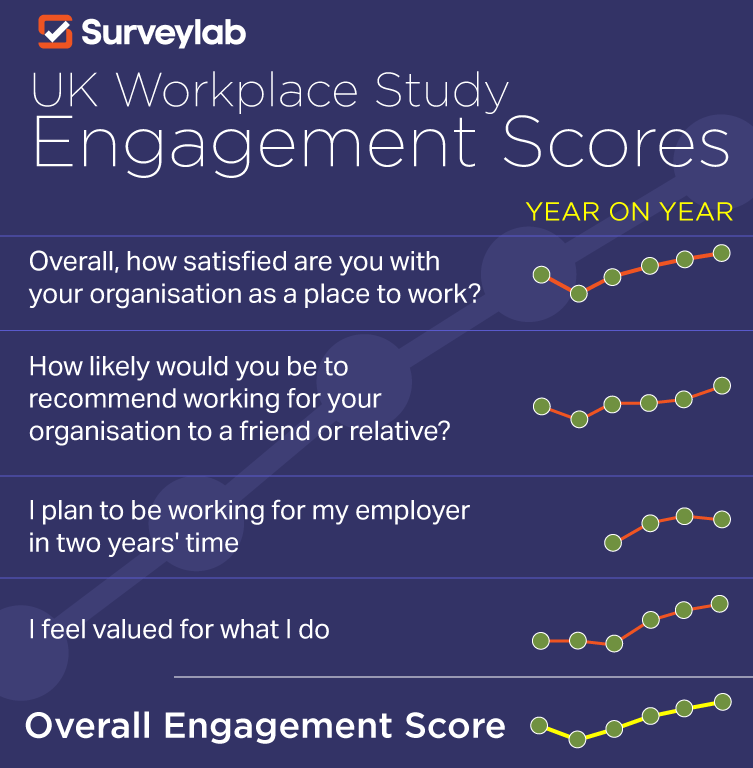
Work is getting better
For the average employee, nearly all aspects of the employee experience are better than they were ten to twelve years ago. Sure, there are always improvements to be made, but we are on the right track.
It won't feel like it to everyone, all the time. Teams and organisations can be facing one or more challenges right now and that affects morale, productivity, capability and so on. There also remain too many toxic workplaces, micro-managers and perhaps the most common issue - capacity and over-stretched employees. There is much still to do.
Because it's not dramatic though, steady improvement doesn't get the headlines. But any psychologist will tell you, target small changes to make lasting impact. And that’s what we're most interested in.
We still have work to do
People want to do a good job. I don't know why but in the very first study we ran, this finding is the one I always remember.
Organisations need to help their employees do a good job. The question turns to are the employees' needs being met? As our understanding and awareness improves, so do our expectations.
The themes we see in our clients' survey data and this year's research are the same: When employees feel the organisation (or leaders) cares for them, that they are valued, they're seen and feel listened to - engagement is high and the organisation performs strongly. The research points at the importance of senior managers being good role models, communication matters and support from - and for - line managers.
"How's work?"
Need some help answering? What's really going on?
If you'd like to know more about our study: let's chat
Surveylab’s employee survey framework shines a spotlight on where your business is right now and what really matters. Looking for real, human insight for the year ahead? We have capacity to kick off one more employee survey in February 2025 - do get in touch (schedule a chat or more contact info here)
About the UK Workplace Study
Each survey was conducted to a random sample of the UK working population; the demographics reflect the working population’s profile by region, sex, age, size of company (self-employed and 1-person companies were excluded from the survey).
The scores are the average score of all responses received using the scale:
'Strongly Disagree' = 0, then 25 / 50 / 75 for each answer, and 'Strongly Agree' = 100
The Engagement Score is the average of the 4 measures:
| Question | 2018 | 2021 | 2024 |
| Overall, how satisfied are you with your organisation as a place to work? | 68.1 | 70.1 | 71.5 |
| How likely would you be to recommend working for your organisation to a friend or relative? | 64.1 | 64.6 | 68.3 |
| I plan to be working for my employer in two years' time | 66.3 | 68.7 | 67.2 |
| I feel valued for what I do | 61.6 | 64.4 | 66.0 |
| Overall Engagement Score | 65.0 | 67.0 | 68.2 |