
What's it really like to work 'here'? (Part 1)
The real state of the Employee Experience in the UK? How do you measure up?

Work has been quite busy of late. In recent times we've had...
- Quiet quitting
- Quiet hiring
- Demands that everyone returns to the office at least 2 times a week
- The shock that the workplace has been taken over by millennials
- Everyone needs to find their resilience
- Mental health awareness (for one week only, mind)
- New demands that everyone returns to the office 4 times a week
- Why you need to be on a side hustle
- So many meetings
- The death of email (no really, this time we mean it)
- Your job can be done by A.I.
- Actually, let's bring back conscription
- And all this before we get into remembering all the various strikes and how much the cost of living crisis hurts
I am sure I have missed a few?
Modern work sounds awful! So, when we start working on a new employee survey for an organisation, there's one question that lots of clients arrive with
"Are we doing ok?"
Sometimes it's asked as:
- "Where are we?"
- Or, my personal favourite, "what's the pulse of our organisation?"
And once we start getting results in from the employee survey, the very first thing we do is get a feel for what the employee experience is like.
We might be interested in some specifics depending on the survey's objectives and what we've discussed or learned working with the client so far, but first step is always to answer: what's it like to work here?
I'm going to use Surveylab's UK Workplace Study to demonstrate a very quick approach to finding the answer.
Look for key measures
We categorise all the survey questions into one of two groups - measures and drivers.
- 'Measures' are what we look for in engaged staff - outcomes like employees enjoy coming to work, would you recommend, their intention to stay at the company and so on.
- 'Drivers' are elements that make up the employee experience - the working environment, our training, communication, interaction with managers and coworkers, etc.
Looking at our UK Workplace Study data, about 1/3 of employees are very satisfied and / or definitely would recommend or plan to be working for their employer in two years' time.
A further 1 in 3 are also positive towards their work and the organisation they work for (just not as strongly). We can convert all of the answers into scores, and roll these up into a single score1.
This is what average employee engagement looks like:
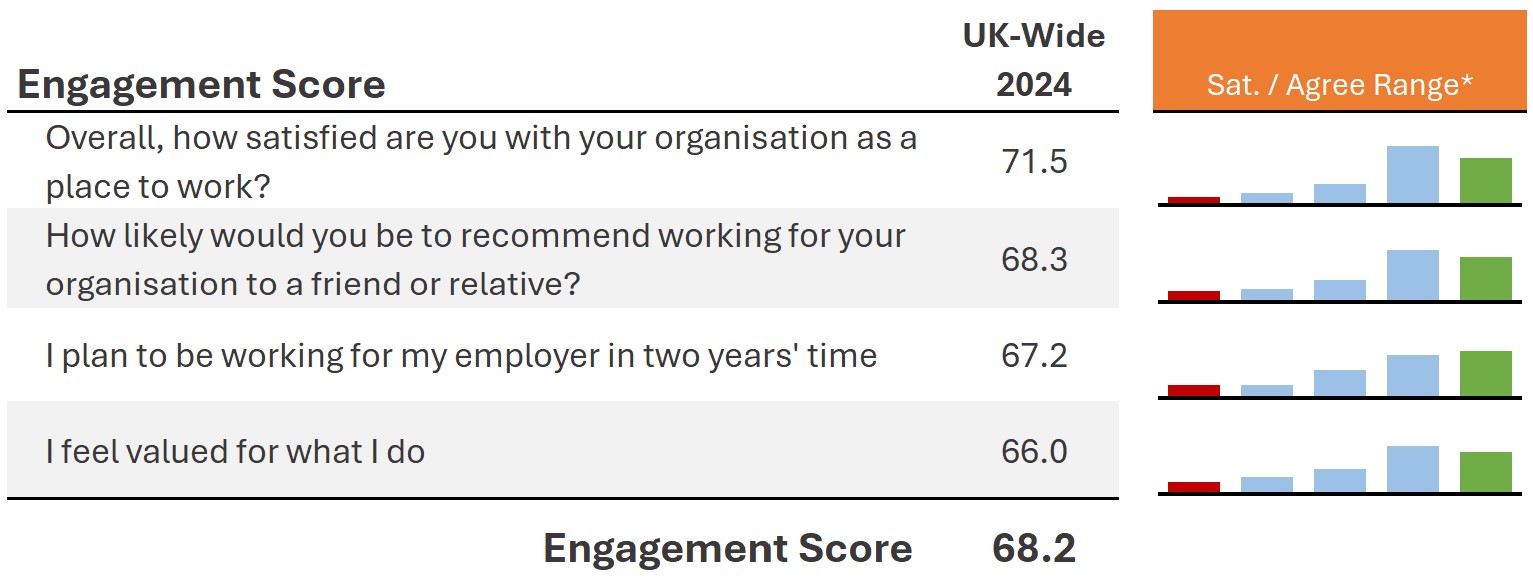
See footnote for quick explanation of how scores are calculated2
This "average employee engagement" score is for the whole of the UK working population. 68.2 isn't a great score but it's not like everyone is quiet quitting or dodging work by WFH and other fears about how poorly we do work.
As an aside, Private Sector employees' engagement score are about +1.5 points higher and Public Sector are about -2.5 points lower.
Your score might be a lot, or a little, higher. Or lower.
Once you have your overall score, you want to check:
Is your engagement score about the same across all of the organisation?
Or are there pockets of excellence or areas that need support?
Is it a surprise? Does it confirm what you suspected?
Now you start to have an idea of what's it really like to work here and how people feel about their organisation.
Then, the most important question to follow up with is why? What’s driving the engagement score?
(that's my next post)
How does your employee experience measure up?
We can help with your next employee survey. Contact us